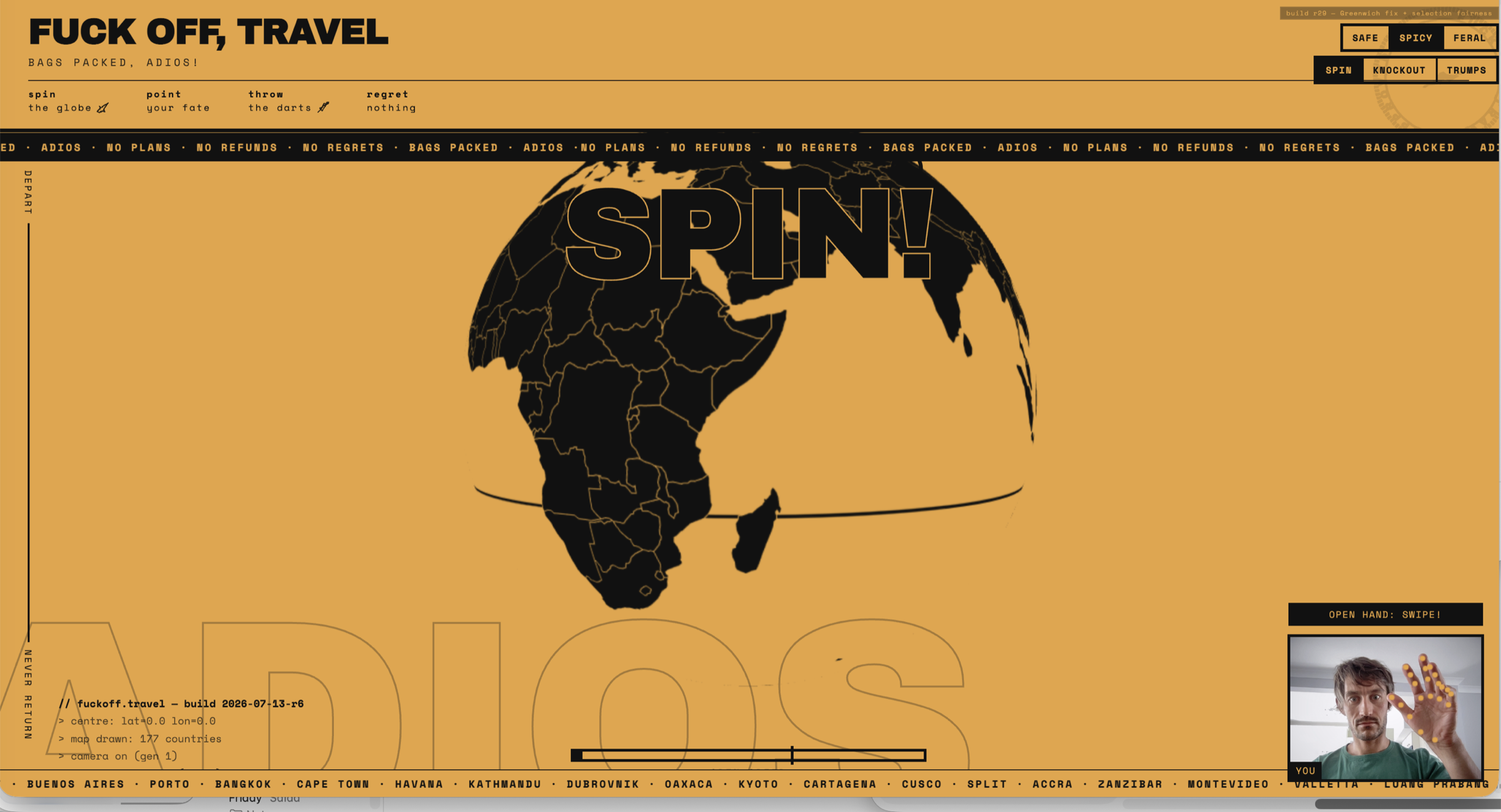
My friend Poki is a motion designer and multidisciplinary artist. Very talented. Recently, she built something impressive: a camera-controlled hand-gesture interaction piece. Real-time pose estimation, fluid motion design, technically beautiful. Your hands became the interface.
But impressive isn't the same as useful. I'm a product builder by instinct. When I see a technology that makes a screen feel physical, my first question is always: where's the application? What decisions could you make with your hands that you currently make by scrolling?
Travel was the answer that stuck. The first thought that came to me was: SPIN a globe then POINT your finger, and voila - that's your destination! It's not the most obvious application, but because travel planning is one of the worst examples of algorithmic recommendation I can think of, it made sense. And because the idea of using your body to make a decision, spinning something, throwing something, flipping something, felt right for a decision that's supposed to be exciting. Travel should feel like an adventure before you even leave. Instead, it feels like scrolling a feed.
Poki's work made me want to build something where the interaction itself was the point. Where the way you chose mattered as much as what you chose. So I started building Fuck Off, Travel.
Algorithms? yawn
Every travel platform shows you the same thing. The same curated lists. The same "hidden gems" that three million other people have already found. The same algorithm serving you variations of places you've already been, because your history is all it has to work with.
The problem isn't that these recommendations are wrong. They're often fine. The problem is that they're quite boring, predictable. They strip the spontaneity out of something that's supposed to be spontaneous. I watched a video on Facebook and saw someone going to an airport desk asking 'What's the cheapest flight that leaves within the next three hours?' and he bought the ticket. That's spontaneity! How could we capture that in a travel platform?
There's a deeper issue too. Recommendation algorithms optimise for engagement, not experience. They show you what's most likely to keep you scrolling, not what's most likely to change your perspective. The result is a narrowing of possibility. You end up choosing between five beach destinations that an algorithm thinks you'll like, when the trip that would actually change your life might be to a landlocked country you've never heard of.
I wanted to build something that did the opposite. No algorithm. No recommendation engine. No curated lists. Just chance. Let chaos decide, and see what happens. And really, it was just an opportunity to test out this hand-camera interaction.
How it works
The name sets the tone. Fuck Off, Travel is deliberately blunt. The design is brutalist: black backgrounds, mustard-yellow accents, heavy type. It looks nothing like a travel app, and that's the point.
The aesthetic draws from two sources: the brutalist archival energy of Rebel9's Memory Library installation and the vintage filing cabinet aesthetic of Memory Library's digital interface. Both treat information like something to be discovered rather than served. The result is deliberately retro, almost nostalgic. Like you're flipping through a travel agent's filing system from 1975, except the agent is chaos.
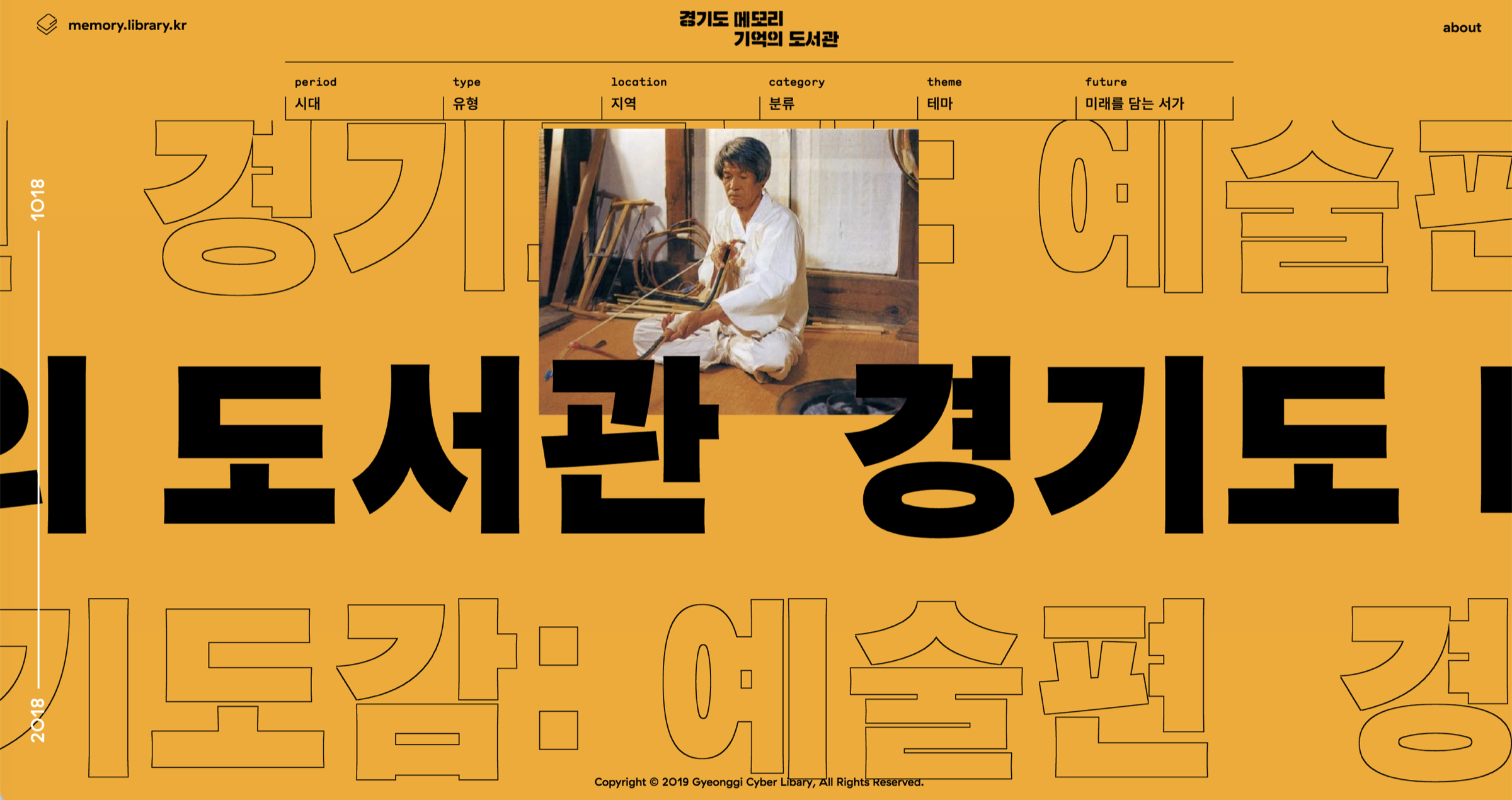
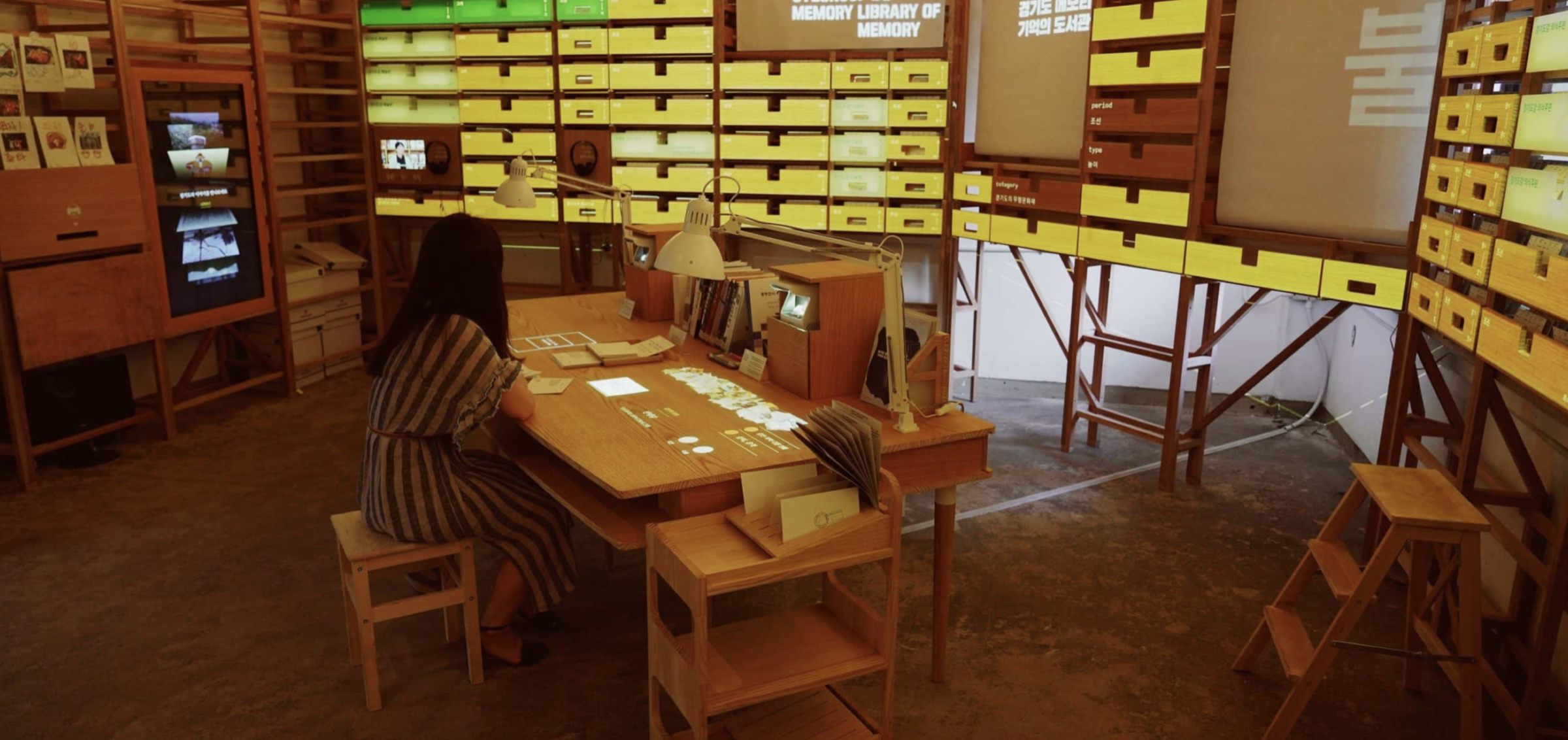
Design inspiration: Rebel9 Memory Library + Memory Library.kr
There are four core interactions, each built around a different game of chance.
Spin the globe
A Three.js globe sits at the centre of the experience. You spin it with your mouse or finger, and it rotates with physics-based momentum, slowing naturally until it settles. Spin it fast enough and it enters a ready state. Point at a country and you've made your choice, not through a search bar or a filter, but through the chaos of a spinning sphere. The interface even adjusts for fairness: larger countries require a longer hold to select, so Russia doesn't dominate every spin.
Throw darts
Once you've landed on a country, you can throw darts at it. Three darts, aimed at the country's mapped outline on a full-screen canvas. Hit inside the border and you've pinpointed a specific location. Miss, and the app tells you about it. "PATHETIC!" "THAT WAS THE SEA!" Each successful hit generates a real place near where the dart landed, pulled from Wikipedia and Wikidata, complete with a photo, a description, and actual statistics.
Knockout
A bracket-style tournament where random countries face off in pairs. You flip a coin to decide each round's winner. Heads, the country on the left advances. Tails, the right. No thought required. Pure chance, applied systematically, until one country is left standing. (Shoutout to my good friend Hurricane Dan - he does the digital nomad thing, and flips a coin to determine his next destination).
Trumps
A card game using real country data. You see one country's stats, population, area, number of languages, highest elevation, and you pick a category. Then a challenger is revealed. Higher or lower. Win the round and advance. It's Top Trumps for geography, and it works.
Chaos levels
Three modes determine the pool of countries. SAFE gives you around sixty well-touristed destinations. SPICY opens it to everything except active conflict zones. FERAL removes all restrictions, and the interface changes to match: the accent colour shifts to acid green, the UI pulses and jitters. A visual warning that you've surrendered all control.
Every interaction is a game of chance. No typing. No filtering. No preferences. You interact physically, through spinning, throwing, and flipping, and the result is whatever it is. The design enforces the philosophy.
Who it's for
The obvious answer is indecisive travellers. People who've been "thinking about going somewhere" for months with twenty tabs open and no booking. But the more interesting use cases are group ones. A stag do where nobody can agree on a destination, so you spin the globe and throw darts until the globe decides for you. A couple who always go to the same places, so they set it to SPICY and let the coin flip take them somewhere new. A group of friends on a video call, each taking turns to throw darts at a country none of them had considered.
It also works for creative decision-making more broadly. If you're the kind of person who overthinks everything, there's something liberating about outsourcing a decision to chaos. You can always say no. But the starting point isn't another algorithm's best guess. It's a dart in a map.
The build (boring stuff - I let AI write this paragraph)
The front end is standard web tech, deployed to Vercel via GitHub with auto-deployment on push. The globe is Three.js with raycasting for country detection. The dart game uses the Canvas API for rendering and hit detection against country outlines. Geography data comes from TopoJSON. Country statistics and descriptions are pulled in real time from Wikidata via SPARQL queries and the Wikipedia REST API. The geolocation API detects where the user is, so the globe orients itself on load.
The visual design uses Archivo Black for headlines and Space Mono for interface elements. The palette is deliberately limited: black, white, mustard yellow, with acid green reserved for FERAL mode. Everything about the aesthetic is designed to feel confrontational, not inviting. You're not browsing. You're gambling.
The trickiest part was the dart mechanics. Mapping country outlines accurately at different zoom levels, detecting hits against irregular polygons, and generating meaningful nearby locations from arbitrary coordinates required a four-tier fallback chain: Wikipedia geosearch within 10km, then Wikidata population queries within 300km, then nearest city over 100,000 within 1,000km, and finally the country's capital as an absolute fallback. That chain means every dart hit returns a real, named place, even if you land in the middle of the Sahara.
What's next?
Honestly: Probably nothing. I just wanted to prove to myself that I could make it work.
However, if I were to take it forward...
Booking integration is the obvious one. Right now the destination pages have "Book Flight" and "Book Hotel" buttons, but they're not wired to anything yet. Connecting to a flight search API would close the loop: spin, throw, book.
Multiplayer is the more interesting direction. A shared session where a group of friends each spin the globe remotely, throw darts at the same country, and compare where they landed. A collaborative decision made entirely through chance. It would work particularly well for the group trip use cases.
An embeddable API is also on the list. The globe component, the dart game, the knockout bracket, these are all modular enough that other travel sites, content creators, or event organisers could embed individual mechanics into their own pages.
And then there's the ironic possibility: travel recommendations based on chaos outcomes. If enough people use the app, you'd start to see which random destinations people actually follow through on. Which ones they share. Which ones they book. You'd have a recommendation engine built entirely from anti-algorithmic choices. An algorithm born from the refusal to use one.
How this fits the sabbatical
I've written about my nine months in Cortes de la Frontera and the projects that came out of it. Fourank, TrackTribe, Datavata, AgniAtlas. Each one started with a personal itch and turned into something bigger than expected.
Fuck Off, Travel is the most recent, and in some ways the most honest expression of what this year has been. I moved to a small pueblo in the mountains, two hours from the nearest friend, and gave myself the space to build things I found interesting. This project started because I saw a friend do something technically impressive and my reaction was: I want to take that energy and point it at something useful. That instinct, seeing something and wanting to build on it, is what the whole sabbatical has been about.
I built every one of these projects alone, from a rented house with a terrace overlooking the Serranía de Ronda. AI tools made it possible to build things solo that would have taken a team not long ago. But the instinct hasn't changed. See a problem. Build something. See what happens.
Have an idea and want to flesh it out? .